Saturday 1 September
We leave the van at really silly o’clock as we know we have an 1¼ hour journey, the session starts at 9.00am and seats are allocated on a first come first served basis. By the dint of power walking from the train to the stadium, we manage to be near front of the queue. Prior knowledge from yesterday means that we are aiming to secure seats on the far side of the stadium in block 225. The less informed are pouring in to the nearest entrances so we are able to sit in the front row of block 225, right by the entrance and exit to what we have learned to call the field of play. In front of us are the competitors who have finished riding and behind us is the support network for British hopeful Natasha Baker, including her father.
We seem to have successfully avoided any irritating fellow spectators. We are here for the Individual Championship Test Grade 2, which means we will see our first medal ceremony. By now we are experts, well we know a free walk and a medium trot when we see one. There are several flighty horses in this class and some are eliminated for ‘non-compliance’. The audience is repeatedly asked to refrain from clapping until the horses are reunited with their handler, or, in some cases, ‘no applause whatsoever’ is requested. As yesterday, waving is encouraged as a substitute. All I can say is that there is some jolly noisy waving going on. When the Canadian rider is taken out of the stadium rather quicker than intended, the audience finally realise that no clapping means just that. Sitting where we do, we appear on the big screen. I try not to make the classic mistake of staring at the screen and look instead at the camera. After a great morning of entertainment, Natasha Baker wins gold with a record breaking score. Chris is excited to see that different types of tractors appear in order to adapt the arena for the medal ceremony. Now our seats are not so good as our view is obscured by the judging booths. Fortunately one of these is fork lifted away by the tractors and we are able to see something of the ceremony whilst, joining in with the National Anthem.

We travel back across London and Chris returns to the van while I meet Martha and go to the Olympic Stadium where we join Becca and Graeme. We sit on the grass for a while with a not very good view of the big screen before heading to the stadium. Having been somewhat distracted by house moving and job changing when Olympic tickets went on sale, Becca and Graeme failed to join the fiasco that was the Olympic ticket lottery. As Martha and I applied for Paralympic tickets before everyone else jumped on the bandwagon, we have several sets of athletics tickets. It was no problem persuading Chris to part with one of his so we offered a pair to Becca and Graeme, whilst all three households continued to try and failed, to get them a pair in their own right. Martha then, understandably, says she is not keen on travelling from the stadium to the caravan on her own after the evening session is over so we have a problem. At the very last minute I manage to get a single extra ticket for me. This has to be downloaded from an e.mail so I add worrying if the e.mail will arrive to worrying if the tickets I posted to Becca and Graeme will make it through the postal system. In the event neither is a problem.
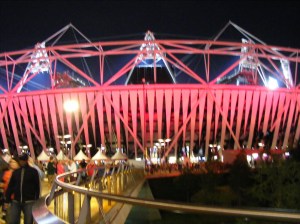
My lone seat has an amazing ariel view from the very back row of what was intended to be press seats, just above the 100 metres’ track. There’s good news and bad news, I don’t like heights but I am under cover if it rains – it doesn’t. With the aid of binoculars I am able to see the other three on the opposite side of the stadium, including watching them looking for me. ‘World record weather’ is announced. Amongst other things we see the women’s shot put F54/55/56 final, the men’s javelin F33/34 final and the Irishman Jason Smythe win the men’s T13 100 metre final. It is a little worrying to note that the javelin area has been situated between the two shot pools. I wonder if they will hit each other. In between jumping up and down (‘as is customary will those who are able please stand’) for medal ceremonies there is plenty of British interest. In the absence of anyone from team GB we are quite happy to forget the history of the past 90 years and pretend that the Irish are still British. Failing that, the Australians will do, indeed almost anyone who isn’t Chinese, who seem to win pretty much everything. And clearly Oscar Pistorius must be British, especially when he breaks the world record in the T44 200 metre heats. As soon as Pistorius has run, people begin to leave and a third of the stadium is empty by 9.30pm. Although this will make leaving the stadium and our journey home easier, I still find it very irritating. Lovely to see the Olympic park illuminated at night and great that Becca and Graeme have been able to enjoy the Olympic experience like the rest of us.
Sunday 2 September
4.00am and Chris is chasing the resident peacocks off the caravan roof. He returns to the van just in time for the cockerels to wake up. The ornithological delights of this site are beginning to pale. It is drizzling when leave home and at least two of our party are wondering if the £4.50 a day parking charge at the station might have been a good idea, to avoid the walk. This weekend seems to have involved quite a bit of walking one way and another and I have developed some interesting looking blisters. After an uneventful journey we divert to M & S at Stratford in the hope of acquiring Martha some gluten free food. This endeavour fails miserably but Chris and I decide to avail ourselves of some pasta salads for consumption later. The downside of this plan is that the pasta salads are not equipped with forks and pasta is a tad tricky to eat with ones fingers. I begin a foray for something suitable. With one eye on the security cameras I acquire some plastic forks from the café. Martha says these are meant for take away salad eaters but I still feel like a shoplifter as I secrete them in my bag.
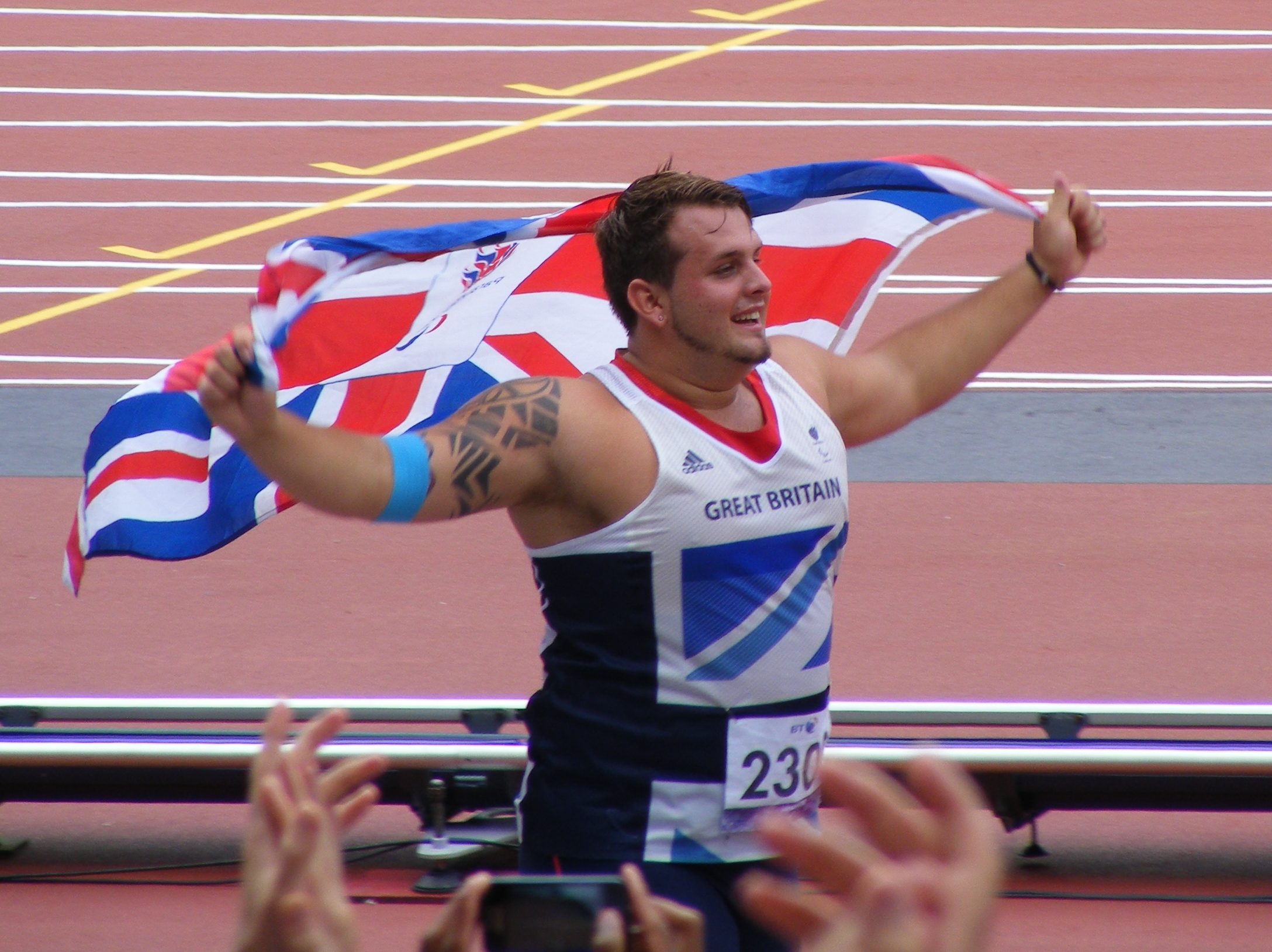
We join the thousands of people heading for the stadium and find our seats near to the front, by the 100 metre track. The commentator is having trouble with some of the more exotic names; should he not have been practicing? Unfortunately for the commentator, if last night is anything to go by, it will be those with the most unpronounceable names who win medals. The commentator has clearly been on the beer. He is introducing the long jump finalists ‘and third to throw is…’. Not only do we have the continual getting up and down for victory ceremonies but as we are on the end of a row we have to get up for those closer to the middle to leave their seats. They do this with such frequency that Chris is heard to question why he bothered to pay for a seat when most of his time is spent standing up. Our neighbours’ recurrent trips to the refreshment stands are followed by the inevitable trips to the toilets. I decide that no one who is incapable of remaining in a seat for three hours should be allowed in the middle of a row. We watch Aled Davies win gold for GB in the discus.

In the over-long gap between our two athletics session we make a trip to Canary Wharf on the DLR so Martha can eat. The only difficulty comes when Chris tries to find his travel card. He does have a travel card, in fact he has several including, one from our 6th August Olympic trip and two for tomorrow, just not today’s. Finally he finds it and we are on our way. Back at the Olympic park we decide to go in to the stadium nearly two hours early so we can sit down. We are back in block E, high above the 100 metres track and finishing line. There is plenty to watch to pass the time. Mistress Efficient is training games makers in synchronised lane marker and block arranging. They also practice retrieving the lane markers quickly so they are not mown down by wheelchairs completing the first lap. Not easily satisfied Mistress Efficient.
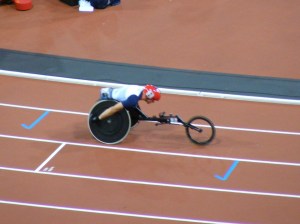
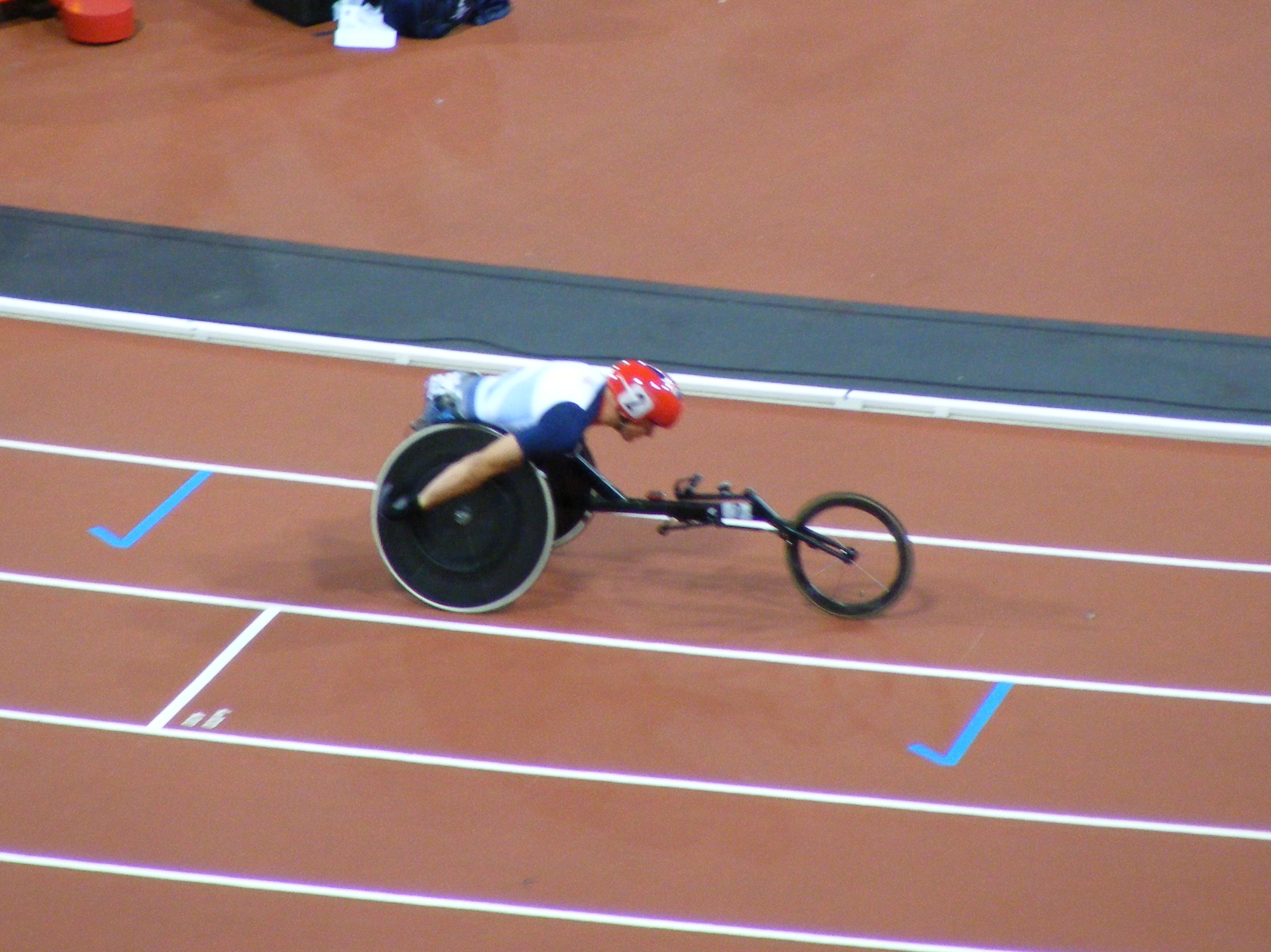
The evening weather is announced as a ‘blank canvas’ and apart from the drizzle first thing, the weather has been lovely. There is plenty going on. The Cuban national anthem is quite jolly. The Brasilians have obviously been practicing, perhaps with an eye on Rio and they do quite well. Oscar Pistorius upsets the form book and is beaten for the first time in nine years by Brasilian, Olivera. We have a good view of Pistorius being interviewed by Channel 4. Martha gets a text to say he is complaining about length of Brasilian’s blades. There is a complicated formula to ensure that blade length is compatible with legs if they had any. The highlight is David Weir’s 5000 metres gold medal. Everyone is on their feet and the stadium is in uproar, this is definitely the best side of the stadium on occasions like this. More excitement follows as the Duchess of Cambridge comes out to present the medal to Aled Davies. What an incredible day.

Oscar Pistorius
David Weir
Monday 3 September
The morning Olympic weather forecast is ‘very promising’ and it is a glorious day. Back in very back row, we observe that every Brasilian athlete seems to be called Santos. The F11/12 (visually impaired) discus is in action. Some of these athletes have no sight at all and guides line the competitors up and some are shouting and clapping to give the athletes a sense of the direction in which they should throw. Paralympic GB continue to do well with Mickey Bushell conclusively winning his 100 metres heat and David Devine winning the 800 metres T12 heat. There is a curious medal ceremony where the Ukranian silver medallist is conspicuous by her absence. It turns out that there had already been one ceremony for this event and the Ukranian had initially been awarded gold by mistake because of a calculation error.

Again we have a six hour gap between sessions. Rather than add to my blisters and return to Canary Wharf on what is a very hot day, Martha nobly agrees that M & S sandwiches will suffice. Chris is suffering from his avian induced sleep disruption and falls asleep every time we pause for a few seconds, including in M & S. Back in the park we sit by the big screen with a better view this time. Inevitably, Chris, who is sitting a little way away from us, dozes off. Next thing we know, concerned games making first aiders are checking to ensure that he isn’t dead. He doesn’t seem to be, so Martha and I resume watching Mandeville and some GB judo players, Ben Quilter who won bronze and brothers Dan and Mark Powell.
We arrive early for the evening session again and watch one of the officials failing to resist the temptation to run on the 100 metres track. We pass the time trying to identify the flags and it takes us a while to realise that they are in alphabetical order. By this time the weather is ‘as promised’ and Mickey Bushell takes the T53 100 metres gold for team GB. Not quite on a par with David Weir, perhaps because it was a shorter race but exciting none the less. The women’s F20 long jump is taking place on the far side of the stadium. This is for athletes with an ‘intellectual impairment’. Martha is excited to see one of the competitors walking along a white line in pigeon steps as this is something she can identify with. She is a little less excited when we point out that the girl is just pacing out the distance for her take off marker. This is an exciting competition and the eventual Polish winner breaks the world record four times in five jumps. The first long jumper lands awkwardly and is injured. Previously Martha and Graeme had discussed which Olympic sport was the most dangerous and Martha had opted for long jump, so she is now vindicated, ‘I told you long jump was dangerous’. Mind you her grounds for selecting long jump were that she was worried that athletes might drown in the sand. We do witness two other non-sand related injuries.
The F42 (one leg amputee) men’s high jump was truly inspirational with several athletes clearing 1.74 metres merely by hopping. The gold was won by Fiji. Then a table appears on the track which is somewhat strange until we realise that it is for the sponges for the T12 5000 metre runners. We cheer on the Argentinian competitor and his guide who complete the final 1½ laps on their own. Greg Rutherford appears on the big screen; he is in the stadium signing autographs. George Osborne arrives to present a medal and is greeted by boos. There is a much better reception for Tanni Grey-Thompson who follows him. Afterward we see her again as we make our way out of the stadium. It really was the experience of a lifetime and it will seem strange that it is all over.

Now back to historical shenanigans.






 The History Interpreter - Janet Few